Misheard

My husband JR and I were bopping along in the car one day when Pearl Jam’s Why Go came on the radio. Right after Eddie Vedder delivered the opening line: “She scratches a letter into a wall made of stone,” JR turned the music down and asked, “Is this song about a cat?”

“It’s about a girl in a mental institution,” I replied.

JR was quiet a moment, then asked, “So why does he say, ‘She scratches the litter’?”

🤣

JR has cultivated a plenitude of misheard lyrics, examples of which inevitably kick off this exchange:

Me: “Wait, what did you just say?”

JR: (giving me a sheepish side-eye) “Nothing. Why? What did they say?”

Me: “No, what did you say?”

JR: “Nothing. I’m not telling you. Just tell me what the line is.”

🤣🤣🤣🤣🤣

Mishearing is a comedic gold mine. During a recent camping trip, our Michigander friend, Holly, was offering tips on our upcoming vacation to the Upper Peninsula when she mentioned, “You’ll see tons of ore docks. They’re everywhere!”

Our friend Rhonda gave her a strange look, then replied, “Okay. I’ll be respectful.”

There was a long span of silence before Holly said, “What?”

“I mean, do I have to bow or something?” Rhonda asked.

After a couple rounds of: “What are you talking about?” “No, what are you talking about?” we figured out that Rhonda, having no concept of what an ore dock is, thought Holly had said “orthodox” and assumed she was referring to some obscure religious sect. And once that was ironed out, we laughed for about three hours.

Here we are in Michigan, keeping an eye out for the Ore-tho-docks

When Rhonda told this story to a couple of Holly’s friends in Michigan, they shared a similar tale of their own. During a phone call years before, the wife was (in her words) “being dramatic” and told her husband, “Well, it’s a cross I’d bear.”

There was a brief pause before he asked, “What are you talking about?”

“You know, like, from the Bible,” she explained.

To which he testily replied: “There’s no cross-eyed bear in the Bible!”

I love these kinds of stories. They remind me of other great mishearings, like my friend who thought the Men at Work lyric: “You better run; you better take cover,” was: “You better run; you better take a bus.” Or JR thinking the Rolling Stones song Beast of Burden was actually called Big Suburban.

And of course, there’s the epic Yellow Ledbetter misheard lyrics by misheardlyricsguy. Since that video served as my introduction to the song, I have no clue what the real words are. In my mind, Eddie’s crooning out lines like: “I wanna leave Bennigan’s,” and, “I said I don’t want a whale in a box or a bag,” with inexplicable intensity.

You know, kind of like he does in that song about the cat.

😹
Share the Love (Gratitude, Part III)

I’ve written a couple of times (here and here) about a gratitude challenge my mom, sister, and I completed from 2019-2020. We liked it so much that this year, we embarked on a new one. Each month, we send someone in our lives a message of gratitude, detailing things we appreciate about them. This can be done by card, email, text, etc. The platform doesn’t matter as long as the message is conveyed.

After six months of engaging in this challenge, I have a recommendation for everyone on Earth: YOU SHOULD DO THIS. Truly, the impact is staggering, while the required effort is minimal. Whether the format is a card, email, or text, the message doesn’t take long to craft, and the process of writing out what you love about a person is really heartwarming. Then, there’s the effect on the receiver. Imagine it: you go to your mailbox, open your inbox, or check a text, and what you find is a spontaneous outpouring of admiration from someone in your life, explaining how much you mean to them and how awesome you are.

If a photo could represent what this challenge has been like, it would be this:

Or maybe this:

That is to say, it’s fabulous, and if you’ve been looking for a simple strategy to make life better, here it is. In an environment of doom-scrolling, apocalyptic media, and endless bickering, this is the perfect way to insert some much-needed joy into the world.

Not a Polyglot

I’ve started learning Portuguese, and after two months of daily lessons, I think it’s safe to say I’ll never even know enough to be vaguely conversational. Don’t get me wrong – I’ll keep trying – but by the time I return to Portugal next spring, I believe I’ll have a greater chance of accidentally saying something in Mandarin than I will of forming an actual Portuguese sentence with my mouth.

As someone who speaks only one more than zero languages, I find polyglots downright magical. Not only do they manage to learn whole new sets of words, grammatical rules, and pronunciations, but they’re also willing to practice and mess up a ton, which includes being misunderstood and (if/when people are jerks) laughed at. I do okay with learning new things, but being the subject of mockery…?

Not my favorite.

I have a dear friend who immigrated to the USA from Colombia in her 20s. She has an excellent command of English, but no matter how well someone learns a language, there will always be little oddities to trip them up. While that sort of thing makes me want to sink through the floor, my friend navigates those moments like a champ.

She called me one day several years back, sounding both confused and concerned. At the time, she was employed performing audits for companies that wanted to be more energy-efficient. She’d just gotten a report back from a crew that had completed their work assignment, based on her assessment.

“Mija,” she said, “what do you call those big coolers in restaurants? Like, those giant refrigerators where they keep all the food?”

“A walk-in refrigerator?” I replied.

“Spell that,” she said. I did. There was a brief pause, and then peals and peals of laughter. When she was finally able to catch her breath, she explained what had happened.

During her audit of the restaurant, the manager showed her the walk-in refrigerator, but what she heard him say was “walking refrigerator,” so that’s what she wrote in her assessment of the restaurant’s needed upgrades. When she received the work crew’s report, it said this:

Completed all identified upgrades. We couldn’t find the walking refrigerator, though. It must have wandered off.

In truth, I’d love to know enough Portuguese to make a 1-letter mistake like my friend’s, but I’m lightyears away from that level of sophistication. I’ve got “Slower, please!” and “I don’t understand” pretty well dialed-in, which should be helpful, but I should probably add a few more key phrases, like: “I’m learning – take pity on me,” “Let’s just try to talk with our hands,” and, “Does anyone around here speak English?”

My husband and I agreed to practice Portuguese during dinner. Our learning is being guided by two different apps, both of which seem to lack practicality when it comes to basic communication, so our dinner conversations (translated into English for your convenience) tend to sound like this:

Me: “The chicken at this restaurant is delicious.” (Particularly apt since we’re both vegetarians)

JR: “How great! Does the chicken like to dance?”

Me: “The chicken is tired, but I dance quickly at the bus stop.”

JR: “That bus over there is blue. It is not green.”

Me: “Okay, thank you! Check, please.”

See how prepared we are? Once we’ve learned “walking refrigerator,” I think we’ll be good to go.

A Dream Come True

When I was about 5, I had a terrible dream. Our kitchen phone – a prototypical ’80s cream-colored landline with a loooong, dangling cord – began to ring. I picked it up, said, “Hello?” and a torrent of insects poured out of the ear piece. The stream was so thick and fast-moving, it pushed me out of the kitchen, through the front door, and down the driveway, growing ever larger as it surged ahead. The whole world became black – just an all-encompassing flood of thickly-packed bugs. I woke up shaking all over.

Today, in Western North Carolina, we’re preparing for the emergence of a “double brood” of cicadas. Apparently, sometime over the next month or so, trillions of cicadas will burst from the ground to blanket the entire outside world and fill the air with a constant, deafening roar.

Of all the dreams I’ve ever had that I did not want to come true, “bug flood” is most definitely in the top 5. And yet, here it is, preparing to will itself into existence.

I’ve heard harrowing tales of the last cicada swarm in Western NC. Folks had to use snow shovels to dig paths to their front doors. Home window screens and car windshields were so covered in bugs, people’s views were completely obscured. My friend was riding her motorcycle and thought she’d been shot in the chest, then again in the head, but she’d actually splattered two unsuspecting cicadas. The noise was so loud and incessant, people felt like they were losing their minds. And that was a single brood, mind you – half the size of what’s about to befall us. The possibilities are truly terrifying. How are my dogs gonna deal with this? Will they come in from the backyard covered in cicadas? Or with mouthfuls of cicadas?

Maybe, if it gets too bad, I’ll just act like my neighbors down in South Carolina and call the police. “Hello, 911? I’d like to report a childhood nightmare come to life. Anything y’all can do about that?”

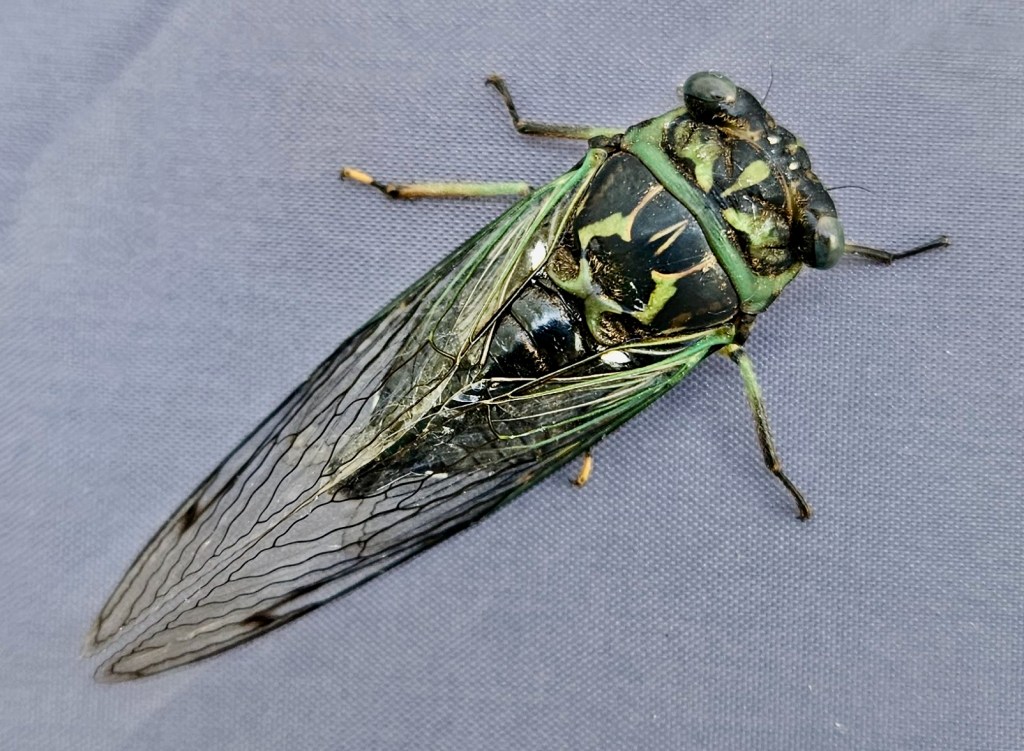
I saw one cicada while camping last summer, and that was one too many. I did snap a photo of it, however, to send to my sister. Over the years, I’ve learned that when I see something and say, “Ew,” my sister would see the same thing and say, “Cool!” So I take pictures of gross things and send them to her.

She was pretty stoked on this one.

Now that I think of it, I may have a solution here. I just need to move my sister back from Spain so she can go through this ordeal with me.

“Look: that car’s completely covered in cicadas! Cool!”

“There are three inches of cicada carcasses on the ground! Cool!”

“The restaurants are serving fried cicadas! Cool!”

“The dogs are pooping cicada parts! Cool!”

Maybe, with her continual reframes, I could survive the bug flood. And maybe, after breathing life into a dream that was so horrifying, I vividly remember it over 40 years later, the universe will see fit to do a little balancing act and make one of my good dreams come true.

I do love a flying dream, universe. Just sayin’.

Walk the Labyrinth

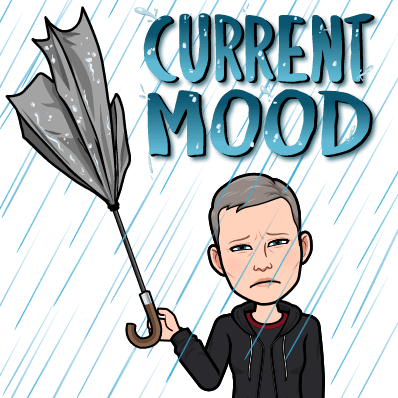
I am an incorrigible brat when it comes to rain. If I’m inside looking out at rain, I can appreciate its pleasant tranquility, but if I’m outside with rain falling on me, I’m more like this:

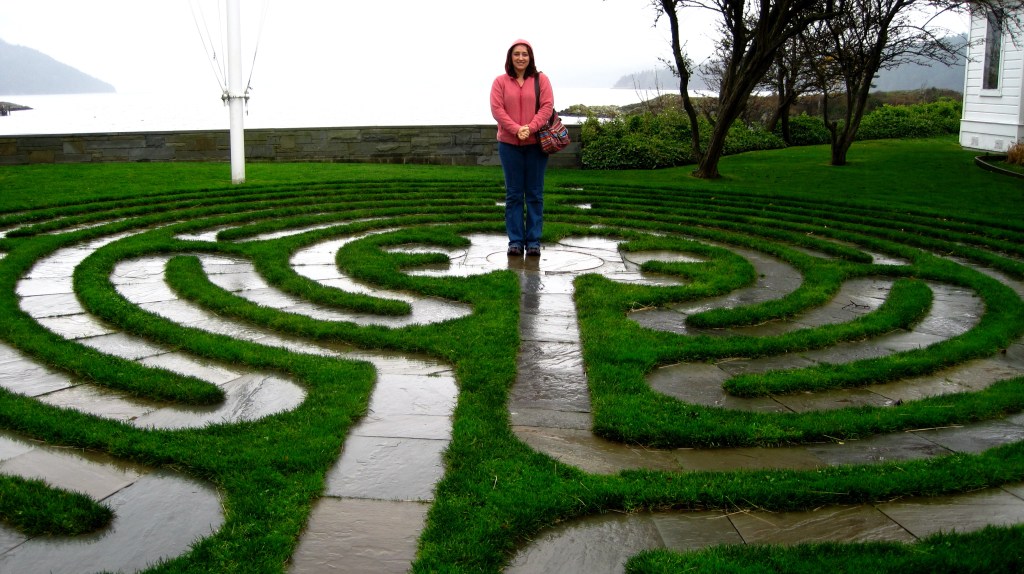
When my cousin Sheri came to visit me on Orcas Island, I did a pretty good job of planning our outdoor activities in accordance with the weather report, but one day, I missed the mark. The skies opened about halfway through our hike, and for the next hour or so, I crankily stomped across the soggy ground while Sheri, who didn’t share my sour attitude towards precipitation, merrily chatted away. We finally came within sight of the car, and I heaved a sigh of relief as Sheri exclaimed, “A labyrinth!”

I glanced over at the pretty green maze beside us and muttered an offhanded: “Yup.” Sheri, however, had come to a stop. Flashing me a huge smile, she said, “I always walk labyrinths.” She stepped to the opening, clasped her hands, and commenced the slowest march ever known to man: left foot, feet together, right foot, feet together. At the pace of your average inchworm, she traveled along the winding path while I stood, mouth agape and water dripping down my face, wondering how rude it would be to wait in the car.

When she finished at last, she turned to me, face aglow with serenity, and all of my impatience and rain-hatred washed away. “You look beautiful,” I told her, then asked her to wait while I retrieved my camera from its waterproof bag to snap a quick photo.

Cousins are the best. In childhood, you play together, and then you grow up and get to see what kind of adults you all become. It’s particularly cool to learn a new life perspective or skill from someone with whom you share one of those uniquely close, “I’ve-known-you-since-we-were-kids” relationships, and I definitely took Sheri’s labyrinth appreciation to heart. Since that day back in 2012, I don’t think I’ve ever strolled right past a labyrinth, regardless of time constraints or weather conditions. Like her, I’ve embraced the opportunity to clasp my hands, bow my head, and take a slow, mindful walk to its center.

Two weeks ago, Sheri passed away suddenly, sending shockwaves through our family. Months before, she and I had commiserated about the Sriracha shortage, and just a few days before she died, I found out production had begun again and ordered two big bottles. My plan was to send her a photo of me holding the bottles, with the caption: It’s back, baby! But I never got the chance.

Death is insufferable with its finality. I want to grab it and scream, “No! I wasn’t done knowing her yet!” But Death doesn’t care. It takes and takes and makes no excuse for itself.

I will always remember Sheri for her luminous spirit, cutting humor, adventurous nature, and unconditional love. And whenever I walk a labyrinth, I’ll hold her even closer to my heart, grateful for the day she taught me, when the universe places a spontaneous meditative ritual at your feet, the correct answer is: “Well, thank you so much. Don’t mind if I do.”

Yes, even in the pouring rain.

Messy

After Dad died, I cried every day for a year. Before then, I pretty much cried annually, and while I recognized that wasn’t the healthiest practice, I still considered it a point of pride.

It was interesting timing, becoming an emotional basket case right after Dad’s death. Dad wasn’t a fan of emotions. In my early childhood, he identified me as “too sensitive” and taught me how to think my way out of uncomfortable feelings. There’s no point in crying; it doesn’t change anything. Nightmares aren’t scary; they’re not even real. Sure, that’s sad, but it is what it is. Etcetera etcetera – the basic message being: bad feelings serve no good purpose and should therefore be logicked away.

I loved my dad. I admired him, wanted to make him proud, and valued our connection. And so, as my grief counselor so eloquently put it, in the early years of my childhood, Dad and I worked together to cut away a key part of me – my highly emotional self – and set it out to sea.

Now, if it had actually gone out to sea and disappeared over the horizon, all would’ve been well, but that’s not how a human system works. The stuff we ignore or suppress lodges itself in the body, then creeps out in other ways. In elementary school, I wrote stories that centered around conflict, with characters constantly shouting at each other. This baffled my parents, since we didn’t have a “yelling house.” Where was this melodrama coming from? At age 12, I was diagnosed with TMJ disorder and started wearing a night guard to keep from grinding my teeth down to nubs. Around that same time, migraine headaches became a regular thing. Later, I turned to numbing agents like smoking and drinking – anything to hijack emotions or turn them off completely. My body had plenty of messages for me, but I ignored them, having fully embraced my stoic, tightly-controlled sense of self.

At almost-50, I finally feel ready to relieve my body of its burdensome store of stifled emotions. Some of the work is underway, like validating negative feelings when they show up. As a mental health worker, this is something I’ve done for others for well over twenty years, so I suppose I’m a bit overdue in affording myself the same consideration. It’s actually a very simple act – far more so than analyzing the shit out of vulnerable emotions in an attempt to turn them into something else. I’m so well-versed in that process, though, that it’s hard to remember, in the moment: It’s okay to feel sad about this. It’s okay to feel nervous about this. It’s okay to feel discouraged by this. But I’m working on it.

I’m less sure how to tackle the other part: releasing all the feelings my body has smooshed into various muscles, joints, and organs over the past four decades. I talked with someone recently, however, who said that’ll be my heart’s work, not my brain’s, and that was a relief to hear, cuz when I asked my brain to figure out an emotional unclogging strategy, it just sent back the shrug emoji.

They say our ancestors live in our bones, so I like to imagine that Dad and I are doing this work together, kind of like a post mortem group project. That being said, Dad did love to delegate, so I see our group project more like this scenario, when Dad took out a couple of lawn chairs so he and his grandson could watch these guys fix the road:

In the case of my current project, as I toil and question and fail and succeed, I’ll picture Dad sitting in a lawn chair nearby, leaning slightly forward with his hands in his lap, saying, “Good job with all that emotion stuff, kid. Keep it up.”

The Winter Doom Reframe

This year, I’m bound and determined to appreciate winter, as I’ve made a commitment not to dread or fear anything over which I have no control (a mandate I need to repeat to myself about a thousand times a day), and impending winter falls squarely into that category.

I shared my new intention with one of the leaders of a retreat I attended last weekend, and he told me the following story:

“The other day, I was directed to commune with a tree. In our conversation, the tree told me that it’s thankful to shed its leaves each year. It feels so much lighter and freer without them.”

This was a helpful reframe, since the sight of skeletal, leafless trees usually makes me sad. Now, when I look up at a sea of bare branches, I’ll think, Well, don’t you look joyfully unburdened?

Another leader at the retreat took us on a walk through the woods and brought our attention to the fallen leaves. She mentioned that people usually think of the brown, brittle leaves as ugly, but in fact, they’re a shade people try to replicate in their dyes and clothing because it’s so beautiful. In addition, they play a critical role in the forest’s life cycle, breaking down to nourish the soil.

Again, this shift in thinking was a welcome one. Normally, when I see autumn leaves, I think, They’re pretty, but they’re a harbinger of evil winter. Now, when I see the leaves in their final stage, I’ll think, They’re pretty, and they’re going to feed the forest.

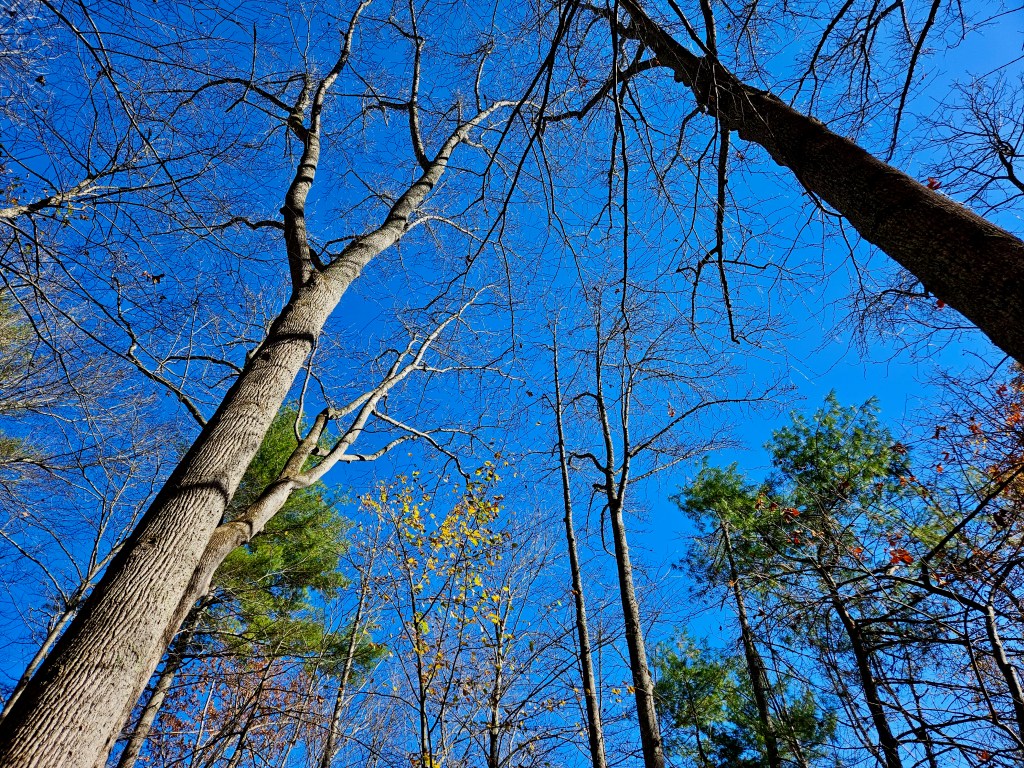
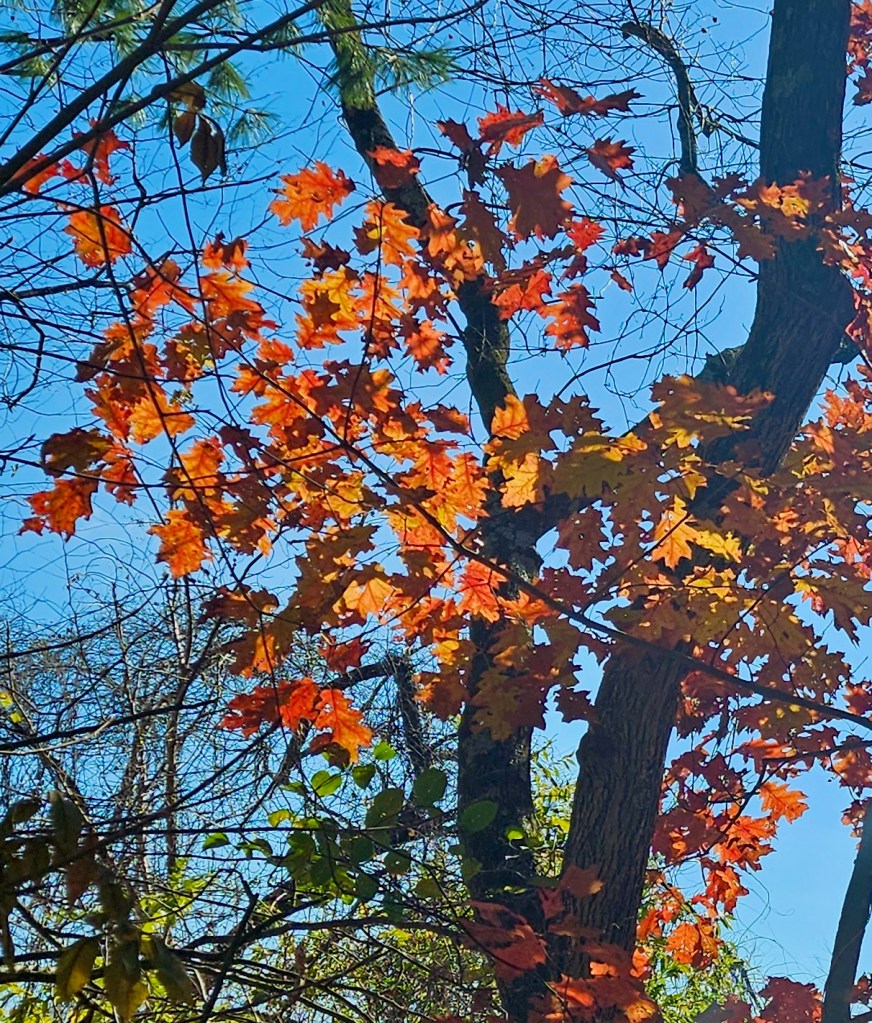
I recognize that a lot of our personal happiness depends on positive reframes, so I’m excited to incorporate these gems of wisdom into my emotional lexicon as winter approaches. Over the next couple of weeks, when I pass this part of my walking route:

…I won’t think, OH NO, THE COLORS ARE ALMOST GONE! WE’RE DOOMED!!

Instead, I’ll remind myself that when those final strips of red and yellow have faded at last, the trees can heave a sigh of relief. Free from the weight they’ve carried, they can shift energy to their roots, then hunker down for a long-awaited, well-deserved rest.

Who Asked You, Jason?

Last year, we visited Ambergris Caye in Belize. Our little condo on the beach had a guestbook, and as soon as we settled in, I started perusing previous visitors’ comments. Several folks offered helpful dos and don’ts, local info, and lots of praise for the hosts. And then I reached this entry:

Leave this place immediately. This isn’t the true Belize. Get out of your comfort zone, people. If you want to be in a place that’s exactly like America, just stay there. – Jason

After my head exploded a bit, I took several deep breaths, then performed a dramatic reenactment of Jason’s commentary for my husband and friends. Everyone agreed that Jason sucked and should fall into a sinkhole. Since no one had written on the other side of page, I tore his entry out of the guestbook and folded it into an airplane, and we all took turns throwing it into the ceiling fan until it was obliterated.

Since that experience, I refer to a specific category of people as “Jasons.” A Jason is much like a Karen, with one important difference. While Karen wants to speak to your manager, Jason thinks he is your manager.

We’ve all met Jason, right? He’s that super fun guy who offers a veritable treasure trove of smug, unsolicited advice, leaving you wondering how you’ve managed to survive without him. And really, how have you? You had no idea what a shit job you were doing at life until Jason popped on the scene to save you from your ineptitude.

I recently met a Jason at a gas station. This Jason informed me that, if I didn’t place my palm on the outside of the car to ground myself between inserting the nozzle and touching my door handle, I would blow up. He imparted this gem of wisdom with pronounced gravity and sternness, as if I had just put myself and everyone in the vicinity in grave danger by skipping his tried and true grounding technique.

True story. I’m telling you, Jasons abound, spewing their guidance hither and yon while remaining entirely oblivious to the prickly social cues of their victims.

By the way, here’s how we felt about Ambergris Caye:

Take that, Jason.

No Shortage of Love

The last time there were reports of a looming Sriracha shortage, my sister mailed me three 28 oz bottles, and Mom sent six bottles along with a Sriracha t-shirt. That shortage never materialized, but I was thrilled with my stockpile. Possessing over 15 pounds of Sriracha made me feel like a super hero.

Now that the Sriracha shortage is real, I’ve received an outpouring of support from friends and family. I imagine my loved ones seeing the headlines and thinking, Oh, no – what will Kelly do?? as they picture me lying on the floor of my kitchen, slowly starving to death in a puddle of tears.

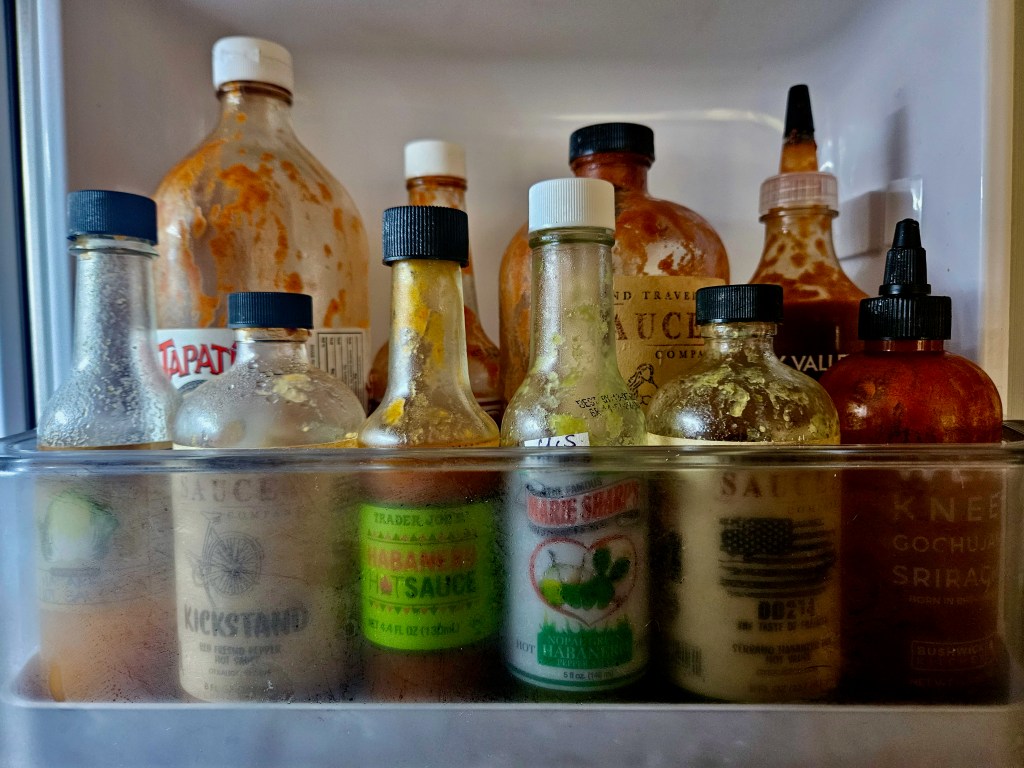
To those of you who’ve shared your concerns: first of all, thank you so much. I had no idea how much love I’d receive in the wake of a Sriracha shortage. Secondly, fear not! In the spicing-up-food department, I’m doing just fine. Here’s my fridge’s hot sauce shelf:

(There’s overflow in the pantry.)

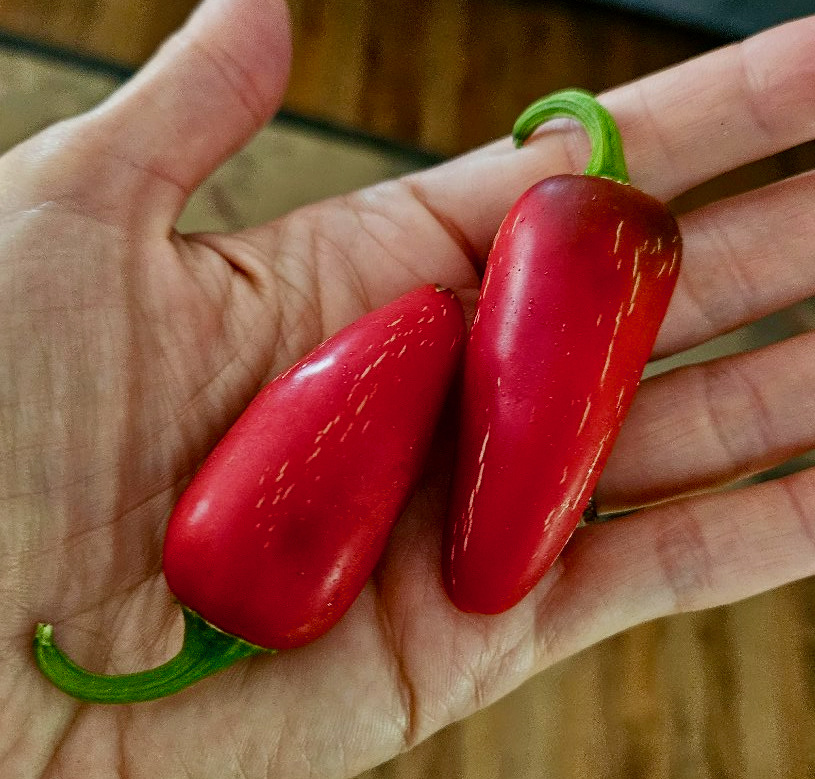
I’ve also discovered a Sriracha substitute from Sky Valley that’s quite delicious, and my husband is busily growing red jalapeños so we can make our own. Here’s how many we have so far:

Better than zero! And aren’t they pretty?

I still miss my Huy Fong standby, but it’s always good to break a dependence, right? I thought I couldn’t live without it, and it turns out I can. That might be even better than having 15 pounds of Sriracha.

That’s Not Real

When I read the book Life of Pi, for the first hundred pages or so, I thought it was a memoir. It wasn’t until the protagonist reached the carnivorous island that I flipped to the front and found the words A NOVEL clearly printed on the cover. Ha! I thought. How embarrassing. I continued to enjoy the book, but not quite as much as I had when I’d thought it was real.

Years later, my husband looked up from the book he was reading and said, “Did you know there was a type of dinosaur that had language and used tools for hunting?”

“What?” I replied. “Where’d you hear that?”

He turned his book – Evolution – to face me, and I pointed at the words A NOVEL on the cover. We had a good laugh. He’d already heard the Life of Pi story, so he knew he was in good company.

For the past couple of months, I’ve been working on a revision of the first book of Aret. Going through it again reminds me of the days when Dad was the book’s chief critic and grilled me continually about wording and plot points. One of my favorite memories from that era was when he took exception to the protagonist’s employment.

Dad: “Why is Diana a carpenter’s apprentice? Isn’t that weird?”

Me: “Women go into carpentry, Dad. One of my closest girlfriends in Oregon is a journeyman carpenter.”

Dad: “But shouldn’t Diana be something else? It just doesn’t seem realistic.”

<Moment of silence in my parents’ kitchen>

Mom: “Isn’t this book about dragons?”

Me: “Yes.”

Mom: “With people turning into dragons and dragons turning into people and everybody flying around between different worlds?”

Dad and Me: “Yes.”

Mom: “And that’s the part you find unrealistic?”

As I began this latest revision with Dad’s voice echoing in my head, I briefly considered changing Diana’s employment to something more ordinary. But then I remembered, if readers aren’t tipped off by the dragons or species transformations or the travels between worlds, they’ll still have that helpful A NOVEL designation on the cover to serve as their guide.

Oh! It’s fiction. Got it. That explains the carpenter thing.