After Dad died, I cried every day for a year. Before then, I pretty much cried annually, and while I recognized that wasn’t the healthiest practice, I still considered it a point of pride.
It was interesting timing, becoming an emotional basket case right after Dad’s death. Dad wasn’t a fan of emotions. In my early childhood, he identified me as “too sensitive” and taught me how to think my way out of uncomfortable feelings. There’s no point in crying; it doesn’t change anything. Nightmares aren’t scary; they’re not even real. Sure, that’s sad, but it is what it is. Etcetera etcetera – the basic message being: bad feelings serve no good purpose and should therefore be logicked away.
I loved my dad. I admired him, wanted to make him proud, and valued our connection. And so, as my grief counselor so eloquently put it, in the early years of my childhood, Dad and I worked together to cut away a key part of me – my highly emotional self – and set it out to sea.
Now, if it had actually gone out to sea and disappeared over the horizon, all would’ve been well, but that’s not how a human system works. The stuff we ignore or suppress lodges itself in the body, then creeps out in other ways. In elementary school, I wrote stories that centered around conflict, with characters constantly shouting at each other. This baffled my parents, since we didn’t have a “yelling house.” Where was this melodrama coming from? At age 12, I was diagnosed with TMJ disorder and started wearing a night guard to keep from grinding my teeth down to nubs. Around that same time, migraine headaches became a regular thing. Later, I turned to numbing agents like smoking and drinking – anything to hijack emotions or turn them off completely. My body had plenty of messages for me, but I ignored them, having fully embraced my stoic, tightly-controlled sense of self.
At almost-50, I finally feel ready to relieve my body of its burdensome store of stifled emotions. Some of the work is underway, like validating negative feelings when they show up. As a mental health worker, this is something I’ve done for others for well over twenty years, so I suppose I’m a bit overdue in affording myself the same consideration. It’s actually a very simple act – far more so than analyzing the shit out of vulnerable emotions in an attempt to turn them into something else. I’m so well-versed in that process, though, that it’s hard to remember, in the moment: It’s okay to feel sad about this. It’s okay to feel nervous about this. It’s okay to feel discouraged by this. But I’m working on it.
I’m less sure how to tackle the other part: releasing all the feelings my body has smooshed into various muscles, joints, and organs over the past four decades. I talked with someone recently, however, who said that’ll be my heart’s work, not my brain’s, and that was a relief to hear, cuz when I asked my brain to figure out an emotional unclogging strategy, it just sent back the shrug emoji.
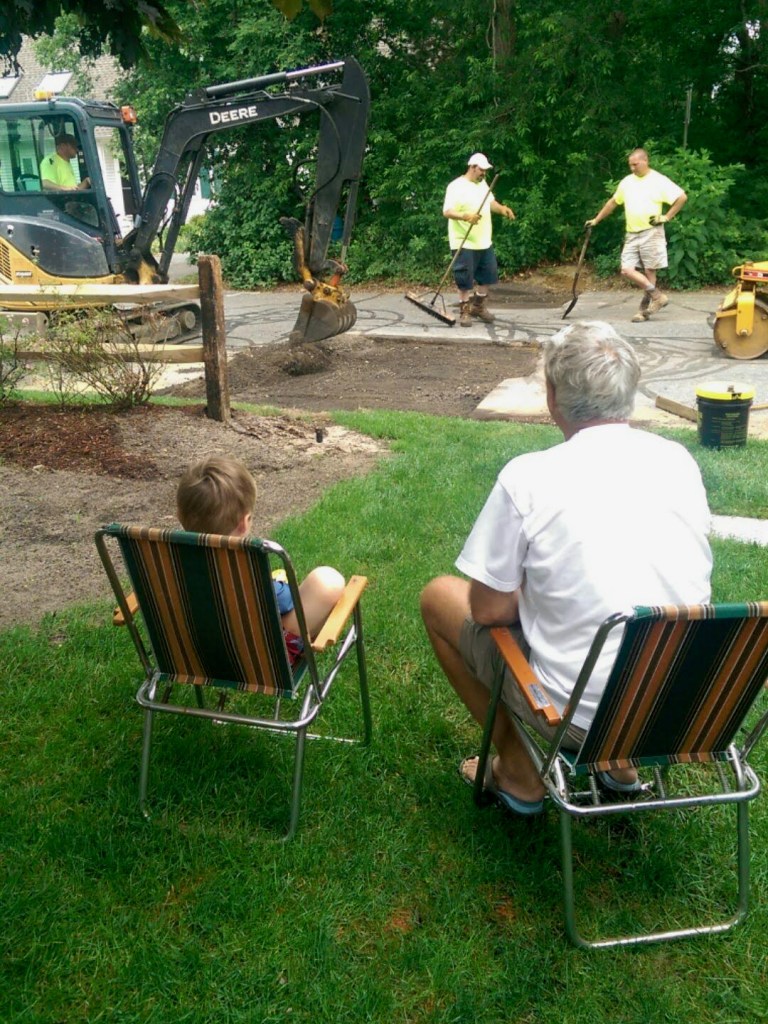
They say our ancestors live in our bones, so I like to imagine that Dad and I are doing this work together, kind of like a post mortem group project. That being said, Dad did love to delegate, so I see our group project more like this scenario, when Dad took out a couple of lawn chairs so he and his grandson could watch these guys fix the road:
In the case of my current project, as I toil and question and fail and succeed, I’ll picture Dad sitting in a lawn chair nearby, leaning slightly forward with his hands in his lap, saying, “Good job with all that emotion stuff, kid. Keep it up.”


 Powered by Dragons