#weathered

A little over a month ago, Hurricane Helene smashed through Western North Carolina, washing away lives, livelihoods, roads, and homes. People are still without water and power. Many have died. Some are still missing. The piles of debris are like a new, tragic set of mountains – giant heaps of gutted houses, smashed cars, and god-knows-what that washed downriver.

Soon after the storm, a friend sent me this diagram, titled The Emotional Life Cycle of a Disaster Explained:
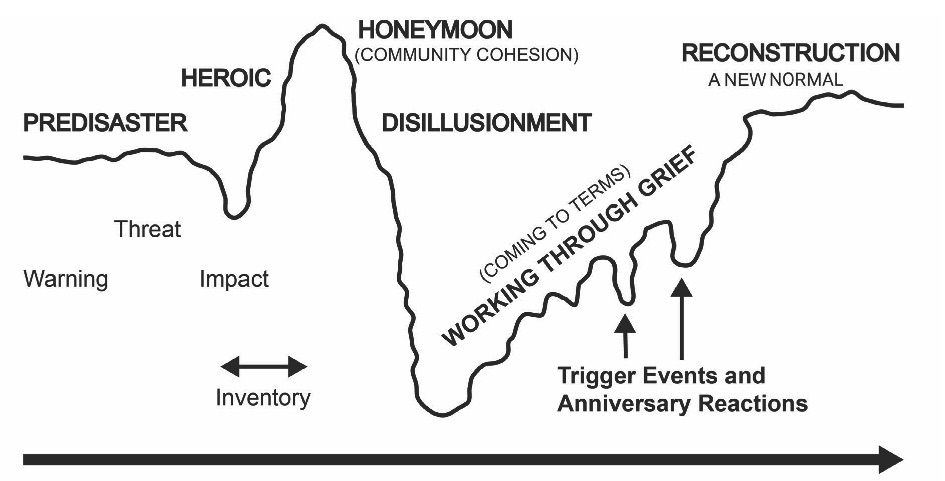
Given the level of destruction in WNC, the timeline between “Honeymoon” and “Reconstruction” will be a very long one, and some things can’t be reconstructed, like the thousands of downed trees. Yes, we’ll plant new ones, but it’ll be hundreds of years before they provide the lush, cooling canopies of the past.

Despite the reality of these dire circumstances, as soon as the storm blew through, the #strong label was everywhere. When did this phenomenon begin – maybe fifteen, twenty years ago? In the immediate aftermath of catastrophes, communities self-declare as, or are proclaimed to be, #strong.

I get the sentiment behind it: We will not be cowed by this. We are brave. We are resilient. We will persevere. And all of that is true. The WNC community has been incredible in its unity, compassion, generosity, and untiring aid over the past month.

But the instant, automatic application of #strong also sidesteps important parts of reaction and recovery. What about mourning and working through grief? What about granting ourselves the grace to collapse a little? What if, as I see scenes of destruction and hear stories of lost family members, friends, neighborhoods, and homes, I don’t feel like being #strong? What if my feelings are more along the lines of #gutted, #exhausted, or #curledinaballofsadness?

When I do feel hopeful, helpful, and encouraged – which is more and more often these days – I’m still balancing those feelings with profound grief and loss, like #strong + #heartache. And that’s okay. Recovery is complicated, and accepting the presence of pain is its own kind of strength.
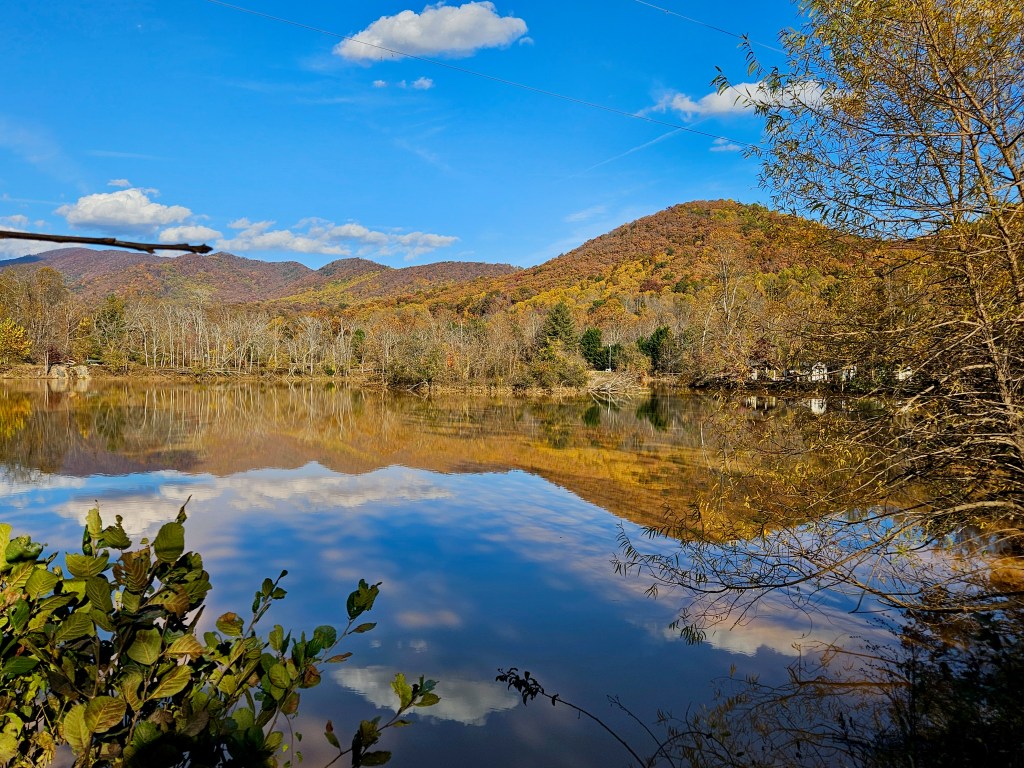
I took this photo last week. It gives me hope. The water, though full of silt, still offers a reflection. Trees are down in those mountains, but many more stand than have fallen. This land grieves, buries its dead, and spawns new life. It is broken, and it is healing, and it is strong.

❤️

[For folks wanting to donate to WNC’s recovery, Beloved Asheville, Samaritan’s Purse, and Hearts with Hands are doing amazing, hands-on work throughout the region, and the River Arts District and LEAF Artist Relief Fund are collecting funds to support and rebuild the arts community.]


Close Encounters of the Ursine Kind

Here in Western North Carolina, black bears abound.

They’re everywhere – clambering onto people’s decks, wandering through yards, invading dumpsters and cars…even doing our taxes (not really, but that would be nice). Compared to the danger factor of brown bears and grizzlies, black bears are more like oversized stuffed animals, but it’s still a bit alarming when they make a sudden appearance. But startling things (provided they don’t kill us) are fun, little reminders that we’re alive, right? So I’m a fan. I guess bears are my Appalachian equivalent of California’s earthquakes, because I thought those were cool, too.

The other night, our dog Titus sounded the alarm that something was amiss outside, and when we threw open the curtain that covers our glass front door, BOOM! Bear.

JR was not at all pleased. With one hand on the doorknob, he shouted, “What do we do?!”

“We don’t do anything,” I replied. “Don’t open the door.” (This seemed like a silly thing to say, but he really looked like he was about to open the door. When I asked him later if he’d planned to do so, he said yes, so I sure am glad I told him not to.)

I banged on the glass, but the bear didn’t give a shit. Giving us a sidelong glance, it stretched the bungee cord on our dumpster just enough to pull out a trash bag, then dragged it into the neighbor’s yard.

By this point, JR had broken into a sweat. “This is not okay,” he said. “He’s way too close!” I reminded him that this sort of thing is the norm when one lives in bear territory, but he wasn’t soothed in the slightest. Even the dogs, who will bark at the neighbor’s cat as if it’s plotting to unleash Armageddon, were utterly cowed by the bear. When they’d gotten a good look at the creature responsible for all the commotion outside, they looked at us like, You know what? You’ve got this. We’re gonna go lie down.

After the bear went away and relative serenity settled back into our home, I thought about JR’s and my differing reactions to the incident. I then recalled that he wasn’t with me for either of my previous close encounters with bears, neither of which involved the luxury of a door, glass or otherwise, standing between me and the big, black fur balls.

Bear encounter #1 took place during our first year in Asheville. I was out walking our dog Libby when something resembling a Newfoundland ran across the street in front of us. Libby was extremely dog-aggressive, so I was actually relieved when I realized the animal was a bear, not an off-leash dog. The relief wore off quickly, however, as it dawned on me that I was alone and unprotected in the presence of a large wild animal. The bear climbed over a fence and into someone’s yard while I left my mom a high-pitched, warbly voicemail about my very first bear sighting.

I’ve already written about my second bear encounter, so there’s no need to revisit all the details here. In a nutshell, I ran myself and my dog Jasper directly into a bear. In my defense, I was distracted by high levels of crankiness at the time.

I suppose, because I’ve had these up close and personal experiences with bears without getting mauled or killed, my panic meter is calibrated differently than JR’s. That being said, I may never throw open that curtain in the den with the naive nonchalance of the past. You just never know what might be lurking on the other side of a glass door.