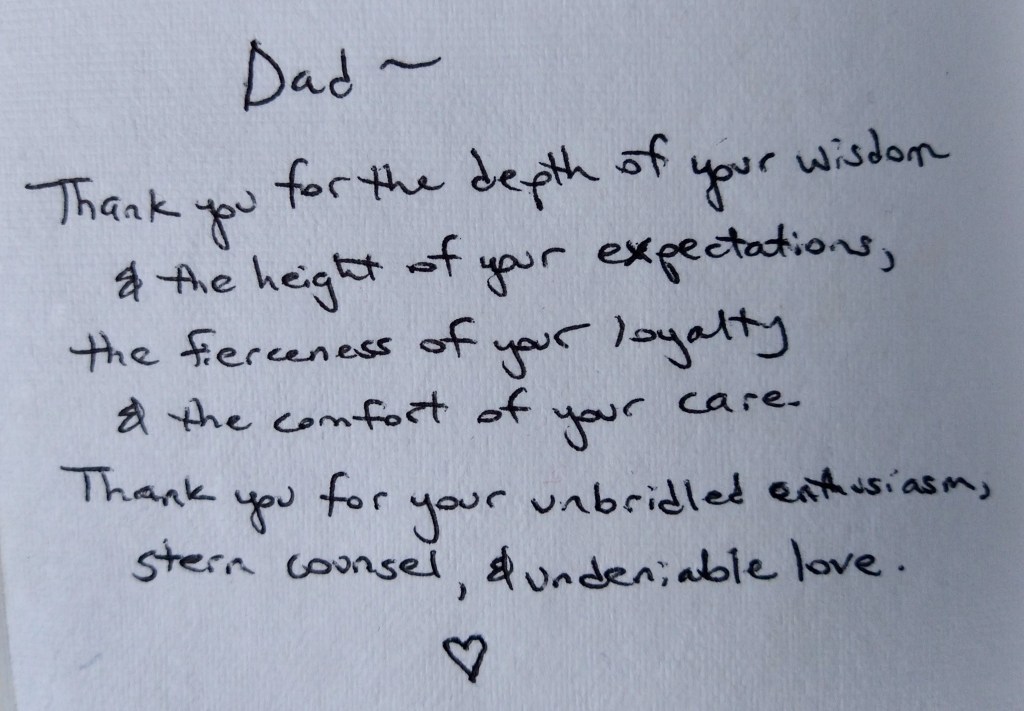
Four Years

On the morning of Monday, September 14, 2020, I received a message from my supervisor, letting me know that my colleague’s mother had died of COVID over the weekend. My heart ached. When I’d talked with my colleague the week before, she’d told me her elderly mother had developed a fever and started to cough, and I knew this was the eventuality she’d feared most.

Needing to clear my head, I decided to take a quick walk before the workday began. About two blocks from home, Mom called. “I can’t believe I have to tell you this,” she said in a tone I’d never heard before. “Daddy died.”

I turned around, already blinded by tears, and stumbled back to the house. My husband’s eyes grew wide when he saw me. I choked out what had happened, and he yelled, “No!” We held each other and sobbed. When I was able to catch a breath, I told Mom I’d pack a bag and head to her house right away. Before leaving, I sent a quick text to my supervisor: My dad died last night. Heading to my mom’s. I’ll be in touch when I can. In the back of my mind, I wondered if my supervisor would even believe me, given that morning’s news about my colleague. What are the chances that both of his employees would lose parents on the same weekend? (As my dad would’ve said: “Apparently 100%.”)

A few minutes from Mom’s house, the skies opened up, and I drove the final mile of steep, twisting mountain roads in a blinding rainstorm. My knuckles were white and jaw clenched tight by the time I pulled into Mom’s driveway. She stood in the garage, her face pinched with worry. Apparently, we were both in the same mindset about the likely outcome of my drive through this storm. Given our family’s recent circumstances – six months into my sister’s cancer treatment, tag-teaming with my parents to care for 8- and 5-year-old boys who couldn’t go to school or see friends, and preparing for my sister’s upcoming hospitalization for a stem cell transplant, scheduled the following week – it would’ve been entirely apt for me to be swept off a cliff by a flash flood on the morning of my father’s death.

But that didn’t happen. We went on. One foot in front of the other. Gallons of tears shed. Countless deep breaths. And somehow, four years passed.

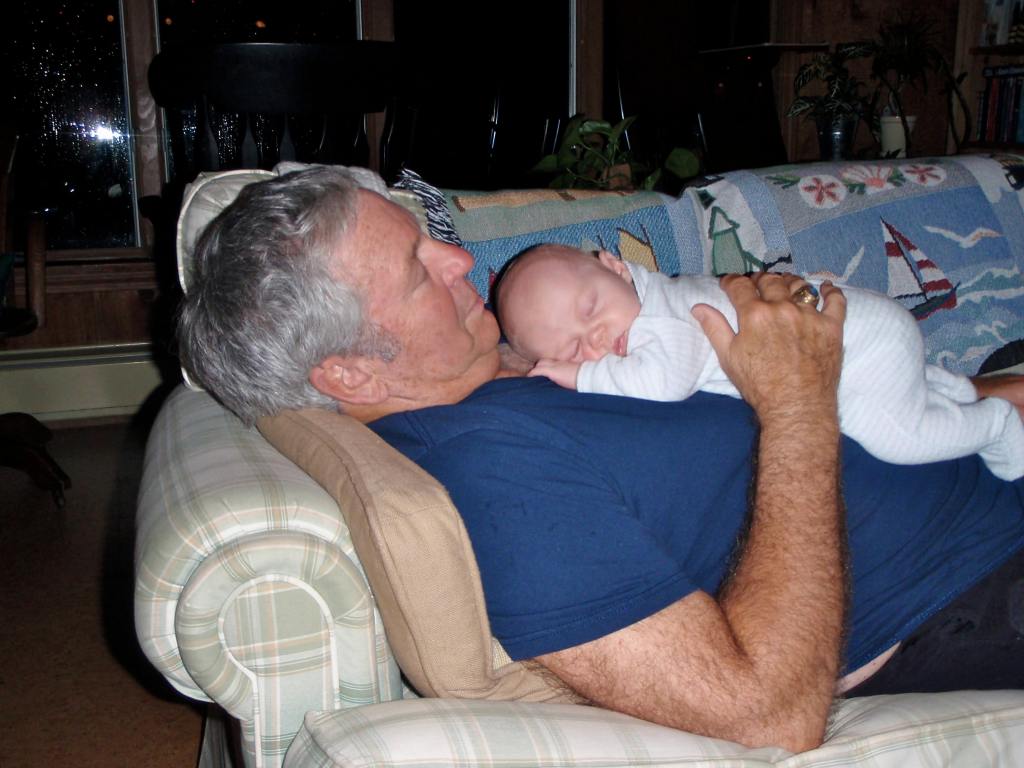
Since I hang the necklace I wear every day on a photo of Dad and me, I look at his smiling face at least twice a day. Sometimes I look at him and think, I’m sorry you missed this. You would’ve loved it. Other times, I think, I’m glad you’re not here for this. Because I know some events would’ve made him furious, or despondent, or just left him feeling helpless.

And every single time the necklace goes on or comes off the frame, I think, I miss you. That sentiment never wavers.
Nadie Sale Vivo, Part II

I have no idea what triggered this conversation 10ish years ago, but the memory will crack me up forever:

[Setting ~ Dad, JR and I watch TV in my parents’ family room]

Dad: “Kelly will be a cougar someday.”

JR & me in unison: “What?!”

Dad: “What?” (pause) “Why, what’s a cougar?”

Me: “A cougar is an older woman who sexually preys on young men.”

Dad: “Oh! Shit. Never mind. I thought it was just a good-looking older woman. Sorry, JR.”

Yup, that’s right. “Sorry, JR.” 🙄 😂

I love this memory of Dad. Simple and lighthearted. Perfect. As the months pass, I find myself treasuring these types of memories the most.

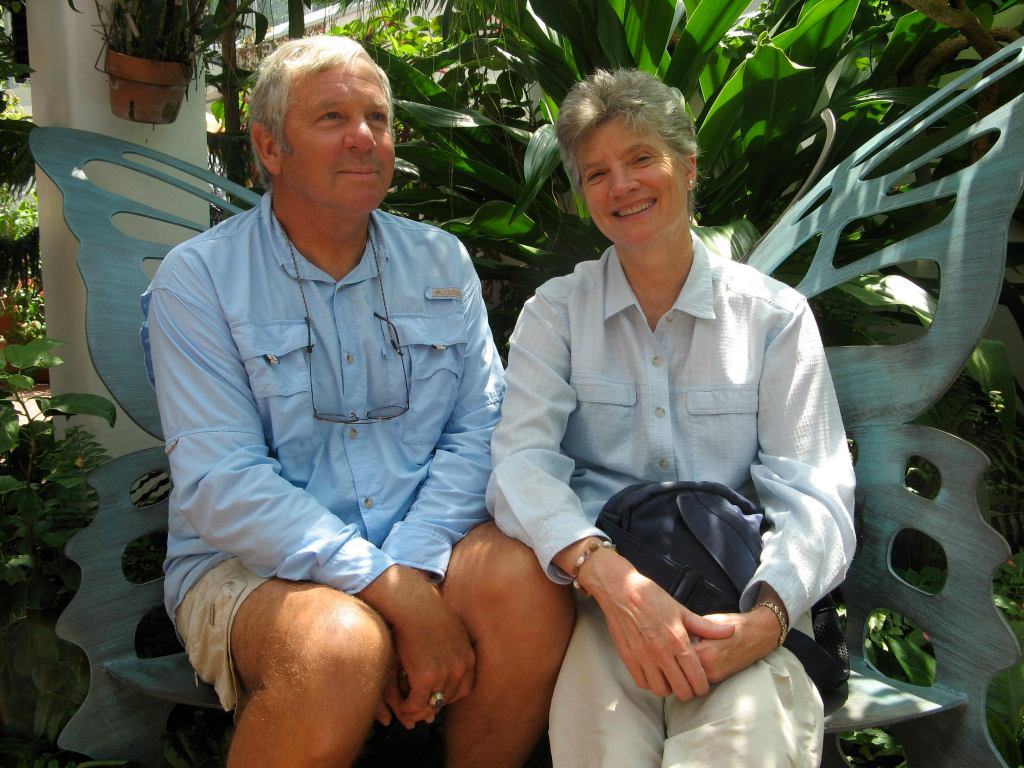
Earlier this week, a group of family and friends traveled to the Marquesas Keys to honor Dad’s life and release his ashes into the waves, per his oft-repeated request. In the photo above, I hold his ashes in one hand and a journal in which I’d written a brief tribute to him in the other. By some miracle, I managed to say the words out loud with a minimum of tearful pauses.

I realize now that I left something out: “Thank you for changing your mind about my future cougar status after you found out what a cougar is.”

It’s interesting to see photos of myself at Dad’s memorial, my arm bearing the words Nadie sale vivo. While people continue to misinterpret the tattoo’s meaning (no, it doesn’t mean I want to kill everyone), for me, it continues to be a helpful reminder to honor each moment of life – each breath, each heartbeat, each moment. It prompts me to hold my loved ones close and leave no kind word unspoken. No one lives forever, not even the dearest dads, and we never know which hug or “I love you” will be the last.

Death Is

The Tao Te Ching was the first religious text I ever read that made real sense to me. It hit home so hard, in fact, that I cried the first time I read it, which was a particularly huge feat at the time (~20 years ago), when I tended to cry on an annual basis.

One theme that runs throughout the Tao is that people erroneously judge and weigh the realities of life. What should be perceived as simple, we complicate. What is truly complicated, we consider simple. And therefore, as we attempt to navigate existence, we spend much of our time completely off course.

In the counseling, reading, and thinking I’ve done on grief over the past six months, I’ve realized my conception of death, and how to respond to it, have been filtered through the very lens described in the Tao. I always viewed death as complicated, but it’s not. Death is simple – neither malevolent nor kind, as plain as it is absolute. There’s no point railing against its wrath, injustice, or unseemly coldness. Death doesn’t answer for itself. It just is.

Many years ago, a friend of mine lost both parents within months of each other, and because I had no idea what to say in the wake of such tragedy, I didn’t say anything. I avoided her, and we drifted apart. I now realize I needlessly complicated the situation. All my friend needed at that time was a benevolent witness – someone to acknowledge the raw pain of her loss. Death is simple, and so is the most meaningful response to it:

“I’m so sorry. I know you’re hurting. I’m here.”

And that’s all. It’s not complicated. I suppose that’s the good news. When faced with another’s suffering, we don’t need to offer advice, redirection, cheer, or distraction, conjure up magical words or devise brilliant strategies to try and salve their pain. All they really want to hear is:

“I’m so sorry. I know you’re hurting. I’m here.”

Simple.