MY Dragons

stiltsmirage

My four-year-old nephew is highly imaginative, and when he was but a wee lad of three, he became the caretaker of a pack of panthers. Panthers are solitary creatures, so I’m not sure why these particular panthers have agreed to hang together. It must just be for my nephew’s sake. He is pretty awesome.

When my nephew chooses to educate me about his panthers, which he does with relative frequency, each informative statement begins with the words, “MY panthers…” For example, if I happen to mention that panthers live in rainforests, my nephew will say, “MY panthers live in castles at the South Pole,” or, “MY panthers live under the ocean. But only sometimes.” His panthers also fly and eat Rice Krispies.

When creating the dragons of Aret, I seem to have channeled the audacity of a very small child. This is one of the nice things about writing within the fantasy genre, as opposed to sci-fi. You can kinda do whatever the hell you want, and the only explanation needed is:  “Because I said so.” “Why do my dragons have human-like hands? Because I said so. Why do my dragons occasionally sit in gigantic chairs? Because I said so.” It’s like a writer’s version of beleaguered parenting.

All of that being said, MY dragons not only have human-like hands (albeit clawed and scaly), but they also have complex systems of government, language, and familial structure, no points of physical weakness, and lifespans that extend for hundreds, if not thousands, of years.

In the Aretian dialect, my dragons are called Teravalta. The Matriarchs are Valtamani, and the Patriarchs – Valtaduri. Our protagonist, the Red Matriarch, is the Valtamani Skara, and her mate, the Black Patriarch, or Valtaduri Noro, is known by Aretian humans as the Norofatela, meaning “Black Death.”

My dragons are divided into eight castes:  Red (Skara), Black (Noro), Blue (Aza), Gold (Arua), Green (Emyr), White (Braza), Indigo (Mora), and Silver (Agno). The Silver and Gold castes are extinct – casualties of an ongoing war – and constant conflict, driven by contrasting views of humans, plagues the other six. For while some castes wish to live peacefully among humans, others see them as an inferior species, valuable only as food.

I’d like to say more about my dragons, but I’m approaching spoiler territory. Suffice it to say that they are supremely badass, though some use their badassery for good and others for not-so-good, particularly if one happens to be human. I will say one more thing – my dragons can travel to Earth and assume human forms. That part is key to the story. And if you’re wondering why or how that happens, well…I’m sure you can imagine what my answer would be.

🙂
The Passage to Aret

IMG_0189

Before moving to Orcas Island in the fall of 2012, I’d had two dreams about dragons. The first featured a woman storming across a bar to confront a man who’d been glaring at her. I remember him as foul and sinister, reminiscent of the Purple Pieman from Strawberry Shortcake, and when she looked down at him and growled, “What the hell is your problem?” he replied, “You, Dragon.” That was the whole dream, but it was enough to inspire a brief note in my journal – something like, “Had a dream re: dragons. Should write a book about it someday.”

In the second dream, I noticed a little hole in my arm, poked my fingers inside, and pulled out a long, thin, dormant dragon. After inspecting it for a moment, I realized I didn’t know what to do with it, so I just let it slide right back through the hole and into my arm. And that was that. There were no feelings of fear, pain, or disgust – only a sense of acceptance. “A sleeping dragon lives in my arm. Good to know.”

I lived on Orcas for 3 months. My intention for that time was to finish a novel I’d been working on for the past year, and, more generally, try to get my head on straight. As it turns out, I picked the perfect place for both. Before I moved there, a long-time resident told me, “Orcas will either work for you, or it won’t. You’ll know its answer right away.” She was right. The island welcomed me with open arms. On my first morning, a river otter ran across the front yard, and bald eagles swooped through the air in front of my little house. On my third night, as I sat journaling on the waterfront, I looked up and saw this.

IMG_9666

Fiery meteors shot through the sky each night. The woods where I took my daily hikes were magnificent, carpeted with thick, green moss and exploding with foxgloves and incredible mushrooms. Even the tree stumps were friendly.

IMG_9695

What I discovered as a newly-unemployed person living all alone was that there are lots of hours in a day. After three weeks, I’d reached the end of the novel I’d gone to Orcas to finish. I sent it to a group of people for feedback, then experienced about thirty minutes of satisfaction before I thought, Huh. Now what am I supposed to do?

One of the ways I’d used all those daily hours was reading the journals I’d kept over the past 15 years, and when I rediscovered my dragon dreams, I decided to revisit the bar scene. Who were those people? Why was that woman a dragon, and how did the Purple Pieman know? So I began to write the story of Aret, and the woman grew younger, feistier, and became Diana Scarlett, and the man softened, developed three dimensions, and became Sien Dolsmati.

In truth, Orcas Island handed me the story of Aret. Whenever I had a question about a character or plot point in a story that became more rich and complicated each day, I set myself on a hiking trail or planted myself by the water, and the answer appeared. I’ve always been imaginative, but when it came to Aret, it didn’t feel like I was using my imagination. It felt like I was figuring something out – something that was already there, floating around, waiting for someone to notice.

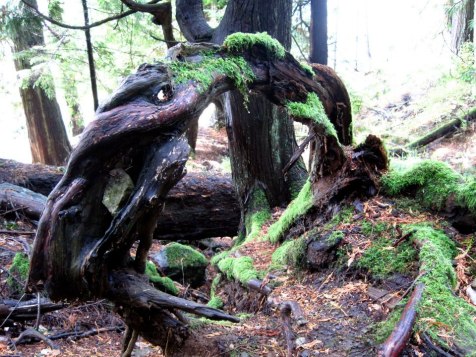
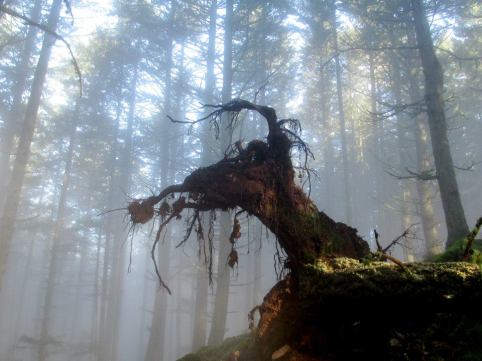
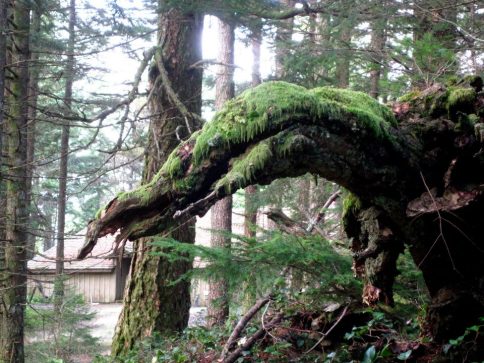
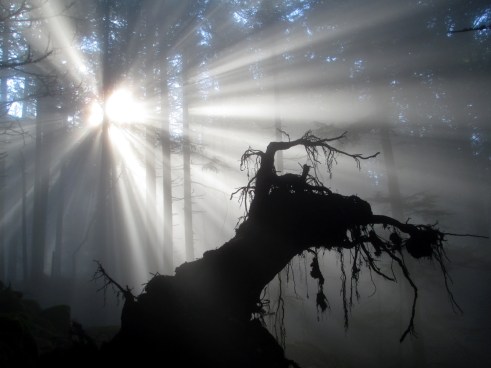
Soon, there were dragons all around me – in the forests, on the waterfront, and in the clouds. At first, I took a picture of each one.

304469_291636680947303_1582327180_n

68399_300074796770158_994355031_n

404624_289237684520536_162511092_n

527434_293428784101426_1093234709_n

But eventually I stopped. There were too many of them. Instead of getting out the camera each time one presented itself, I simply smiled and waved. Yes, hello. I see you. I’m writing your story.

By the time I left Orcas, Aret was written from beginning to end, but it was only a story, not a book. Now, three years later, after much revision, feedback, and more revision, Aret is a true book. And it’s my favorite kind of book, too – the kind that sweeps up its readers and lets them get lost for awhile.

Now all I have to do is publish it.

And write the next two books, because, as it turns out, Aret is a trilogy.

It’s a good thing days contain all those hours.

IMG_0359