“If, after twenty-one years of life, it must be pointed out to you that you are, in fact, a dragon, it’s time to develop some self-awareness.” – Diana Scarlett
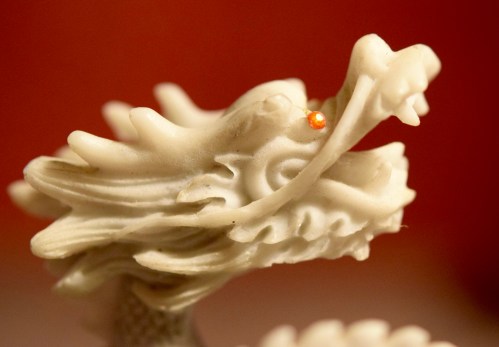
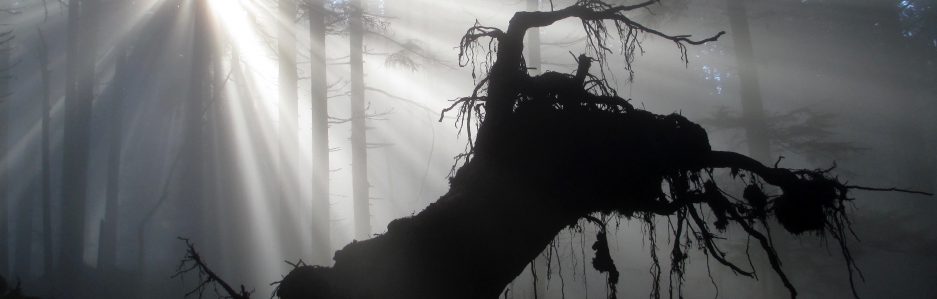
“If, after twenty-one years of life, it must be pointed out to you that you are, in fact, a dragon, it’s time to develop some self-awareness.” – Diana Scarlett
One of the joys of writing is having the opportunity to create kickass female characters. There are far too many undeveloped, unbelievable, uninteresting token females dropped into stories (maybe someday writers will understand that having more numerous and varied female characters makes stories better), so each time a fabulous female is added to the ranks, I like to think it balances things out a bit, male-dominance-wise.
My favorite thing about Aret’s protagonist is that she occupies two bodies: Diana Scarlett – a 21-year-old pacifist, vegetarian, and apprentice with the United Brotherhood of Carpenters; and the Valtamani Skara, a thousand-year-old egalitarian, diplomat, and leader of a race of dragons. Therefore, our protagonist is, as it were, a twofer – two totally tremendous characters wrapped up in one.
Needless to say, when one exists as a dragon on one world, then finds oneself as human on another, complications arise. For example, there are misconceptions and prejudices to face. When the Valtamani conducts her initial research on Earth and reads the humans’ stories about dragons, her reaction is this:
Gold-hoarding monsters, indeed. Dragons do not even have a system of currency.
To further demonstrate the complexity of occupying different bodies on different worlds, here’s a peek at Diana’s diary:
I had dinner at my parents’ house this evening and brought homemade cupcakes, which they pretended to enjoy even though I used way too much salt. Let’s hear it for unconditional love! They asked where I’ve been, since I missed brunch with Nana and didn’t even call, so I let them know I’ve been flying around on another world eating deer heads, guarding eggs, running a governing body, and trying to conjure up a strategy to end a twenty-year war between humans and dragons.
The Valtamani/Diana is imperfect, of course. That’s part of having three dimensions. She can be selfish, impulsive, and cold, but shining a light on those attributes was every bit as enjoyable as showcasing her wit, strength, and snarkiness. Yes, snarkiness. For despite her sophisticated nature, our protagonist has a tendency to be quite snarky in both her human and dragon forms. After a thousand years of life, I believe she deserves a free pass to be an unapologetic wiseass. Hell, I’ve only been around 40 years and have granted myself that license already.

In a recent conversation with my sister, she spoke of a little voice that guides her in making important decisions. Despite the knee-jerk diagnostic tendencies that accompany a background in psychology, I do realize she isn’t suffering from auditory delusions. She simply allows herself to be guided by intuition.
As I listened to her, I wondered why I don’t have a guiding voice. Sure, there’s a lot of chatter in my head, but rarely is this chatter insightful. It’s more like the incessant honking of a gaggle of geese: pervasive, loud, and obnoxious.
Then I remembered that I do have an intuitive sense, although it doesn’t dwell in my head. It lives in my digestive tract. And it’s not a voice; it’s an irritant. My intuition works like this: if I’m making good choices, it remains dormant, but when I fall off my path, it roars to life. And not in a good way.
Throughout the years of writing and revising Aret, my end plan was to self-publish. I felt really good about that option and spent many hours considering how I’d go about it. However, a few months ago, after completing what I like to call my “final revision” (ha ha), I suddenly changed course and decided I should try the traditional publishing route. Despite my stomach’s angry response, I started down the querying path. As I clicked from one literary agency’s website to the next, my intestines contracted with alarm, but I chalked it up to feeling out of my element.
Yesterday, all of that changed. After spending the morning tweaking a corny query letter while ignoring my gut’s furious roiling, I received some serious, family-related news. Since extreme, unexpected personal matters tend to press the pause button on the rest of my life, receiving this news made me freeze long enough to notice that my stomach was on fire. And in that moment of painful reflection, I thought, What am I doing? Life is short. I’m wasting time!
Voila! Just like that, my intuition stretched, yawned, and went back to sleep, apparently trusting that I’d found my way back to the path. Which I have.
As my tummy settled, I remembered all the exciting self-publishing ideas I’d had before stumbling off the rails, and I got all squiggly with excitement. One of the things I’d planned to do was contact a dear friend (also a professional actor) to ask if she might be interested in doing the audiobook for Aret. For free, mind you, because I don’t know if the book will ever make money.
Granted, this is a strange request to make of a friend. Um, want to do a lot of work for no money? Because I would love to hear you read this story. Plus, if I’m going to take anyone on this crazy ride, I’d like it to be you. After all, we have a history of doing that sort of thing.


Building a world is fun and complicated in equal parts. While it’s fun to create a host of new rules to govern one’s land of make believe, the complexity manifests in holding oneself accountable to those rules, which, of course, involves remembering them.
In the early stages of this story’s development, I decided that time runs ten times faster on Earth than it does on Aret. What led to that preposterous, labyrinthine choice? I have no idea. Really, I cannot remember, but considering all the trouble it’s caused, I have to believe it was a decision based on sound logic.
Once the rule was established, Aret’s plot and characters intertwined all around it, creating a sticky mess of narrative knots unthinkable to untangle. So I had to embrace the 10:1 time factor, despite its propensity to cause twitchy eyelids and bouts of explosive swearing.
Throughout the writing of book 1, I thought I took great care in following the terrible time rule, but during one of my nine thousand revisions, I discovered something dreadful. Over the course of the story, about three weeks passed on Earth, which meant that only two days had passed on Aret. However, in every scene that took place on Aret, the sun shone brightly in the sky.

Crap.
That was not a happy realization, but I tried not to panic. I leashed up my dogs, took them into the woods, and commenced an intense, semi-combative internal dialogue.
Inner Me #1: What am I supposed to do about this? Half the scenes on Aret should take place at night!
Inner Me #2: Hmm. Maybe there’s no night on Aret. It’s just day all the time!
IM #1: Oh, Kelly. That is so lazy.
IM #2: True. Maybe I need to get rid of that pesky 10:1 time rule.
IM #1: Okay. Except that means recreating the entire story. Are you up for that?
IM #2: Um, no. Maybe I don’t want to be a writer. Maybe I should be a firefighter instead.
IM #1: Good grief. Quit whining and put some scenes in the dark already!

So I did. I combed through the narrative, figured out the exact timing as characters traveled between worlds (a painful, migraine-inducing experience), and, at long last, incorporated sunsets and starry nights into Aretian scenes.
Bringing darkness to Aret led to another new rule – my dragons have perfect night vision, yet they burn torches in their Council Hall at night, anyway. Why? Well, they’re sophisticated creatures. I imagine they enjoy the ambience.
As I reflect on the process of creating this story, I have one piece of advice to offer other budding fantasy writers. Consider NOT messing with time. Time doesn’t like being manipulated. It just might retaliate.
When I began writing the story of Aret, I knew the protagonist would have a hostile male counterpart, but the details of his character remained a mystery to me. His early conception was as the villain Rotpac – a dragon slayer resembling a vile, decrepit sorcerer. He even had a nasty little henchman. I remember crafting a scene in which he and his toady tortured the protagonist’s mate and forced her to watch. It was gross.
As the story gained momentum, the male character grew in importance, and as his role morphed, his grossness became an issue. Although he was developing into a more complete human being, accompanied by some engaging attributes, at his core, he was still an unsavory individual.

It soon occurred to me that having such an unpleasant primary character might not be agreeable to readers, so I strove to make him less repellent. His name changed from Rotpac to Sien Dolsmati; his appearance, communication, and motivations shifted, becoming softer and gentler, while maintaining the threatening edge required for the story.
These changes weren’t made only for readers, however. An equally compelling reason to make him more desirable was for the sake of our protagonist, Diana Scarlett, who has to spend a lot of time with Sien. As Diana’s character developed, I grew fond and protective of her, and I didn’t want her hanging out with someone so revolting.
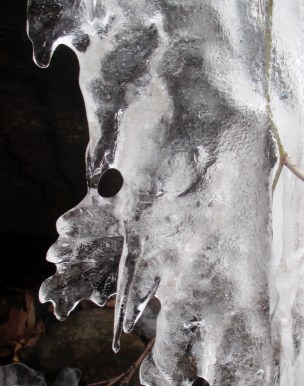
Sien as he lives and breathes today is a towering Aretian human – just over 7 feet tall – with blue lips and patterned skin. He is courageous, patient, and determined, but also hawkish, calculating, and vindictive. While I first envisioned his physical form as gnarled and ghoulish, with inner workings to match, now he is more like this:

And at times, he still goes by the name Rotpac.
[NOTE: Readers sometimes get hung up on the pronunciation of Sien’s name (See-en). Think of it like the word sienna, minus the third syllable.]
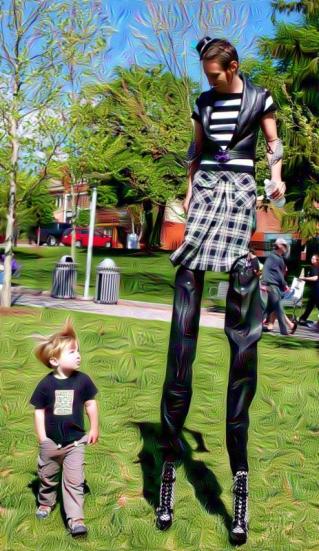
My four-year-old nephew is highly imaginative, and when he was but a wee lad of three, he became the caretaker of a pack of panthers. Panthers are solitary creatures, so I’m not sure why these particular panthers have agreed to hang together. It must just be for my nephew’s sake. He is pretty awesome.
When my nephew chooses to educate me about his panthers, which he does with relative frequency, each informative statement begins with the words, “MY panthers…” For example, if I happen to mention that panthers live in rainforests, my nephew will say, “MY panthers live in castles at the South Pole,” or, “MY panthers live under the ocean. But only sometimes.” His panthers also fly and eat Rice Krispies.
When creating the dragons of Aret, I seem to have channeled the audacity of a very small child. This is one of the nice things about writing within the fantasy genre, as opposed to sci-fi. You can kinda do whatever the hell you want, and the only explanation needed is: “Because I said so.” “Why do my dragons have human-like hands? Because I said so. Why do my dragons occasionally sit in gigantic chairs? Because I said so.” It’s like a writer’s version of beleaguered parenting.
All of that being said, MY dragons not only have human-like hands (albeit clawed and scaly), but they also have complex systems of government, language, and familial structure, no points of physical weakness, and lifespans that extend for hundreds, if not thousands, of years.
In the Aretian dialect, my dragons are called Teravalta. The Matriarchs are Valtamani, and the Patriarchs – Valtaduri. Our protagonist, the Red Matriarch, is the Valtamani Skara, and her mate, the Black Patriarch, or Valtaduri Noro, is known by Aretian humans as the Norofatela, meaning “Black Death.”
My dragons are divided into eight castes: Red (Skara), Black (Noro), Blue (Aza), Gold (Arua), Green (Emyr), White (Braza), Indigo (Mora), and Silver (Agno). The Silver and Gold castes are extinct – casualties of an ongoing war – and constant conflict, driven by contrasting views of humans, plagues the other six. For while some castes wish to live peacefully among humans, others see them as an inferior species, valuable only as food.
I’d like to say more about my dragons, but I’m approaching spoiler territory. Suffice it to say that they are supremely badass, though some use their badassery for good and others for not-so-good, particularly if one happens to be human. I will say one more thing – my dragons can travel to Earth and assume human forms. That part is key to the story. And if you’re wondering why or how that happens, well…I’m sure you can imagine what my answer would be.
🙂
Before moving to Orcas Island in the fall of 2012, I’d had two dreams about dragons. The first featured a woman storming across a bar to confront a man who’d been glaring at her. I remember him as foul and sinister, reminiscent of the Purple Pieman from Strawberry Shortcake, and when she looked down at him and growled, “What the hell is your problem?” he replied, “You, Dragon.” That was the whole dream, but it was enough to inspire a brief note in my journal – something like, “Had a dream re: dragons. Should write a book about it someday.”
In the second dream, I noticed a little hole in my arm, poked my fingers inside, and pulled out a long, thin, dormant dragon. After inspecting it for a moment, I realized I didn’t know what to do with it, so I just let it slide right back through the hole and into my arm. And that was that. There were no feelings of fear, pain, or disgust – only a sense of acceptance. “A sleeping dragon lives in my arm. Good to know.”
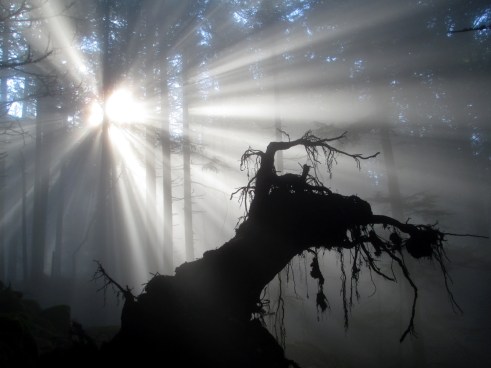
I lived on Orcas for 3 months. My intention for that time was to finish a novel I’d been working on for the past year, and, more generally, try to get my head on straight. As it turns out, I picked the perfect place for both. Before I moved there, a long-time resident told me, “Orcas will either work for you, or it won’t. You’ll know its answer right away.” She was right. The island welcomed me with open arms. On my first morning, a river otter ran across the front yard, and bald eagles swooped through the air in front of my little house. On my third night, as I sat journaling on the waterfront, I looked up and saw this.

Fiery meteors shot through the sky each night. The woods where I took my daily hikes were magnificent, carpeted with thick, green moss and exploding with foxgloves and incredible mushrooms. Even the tree stumps were friendly.

What I discovered as a newly-unemployed person living all alone was that there are lots of hours in a day. After three weeks, I’d reached the end of the novel I’d gone to Orcas to finish. I sent it to a group of people for feedback, then experienced about thirty minutes of satisfaction before I thought, Huh. Now what am I supposed to do?
One of the ways I’d used all those daily hours was reading the journals I’d kept over the past 15 years, and when I rediscovered my dragon dreams, I decided to revisit the bar scene. Who were those people? Why was that woman a dragon, and how did the Purple Pieman know? So I began to write the story of Aret, and the woman grew younger, feistier, and became Diana Scarlett, and the man softened, developed three dimensions, and became Sien Dolsmati.
In truth, Orcas Island handed me the story of Aret. Whenever I had a question about a character or plot point in a story that became more rich and complicated each day, I set myself on a hiking trail or planted myself by the water, and the answer appeared. I’ve always been imaginative, but when it came to Aret, it didn’t feel like I was using my imagination. It felt like I was figuring something out – something that was already there, floating around, waiting for someone to notice.
Soon, there were dragons all around me – in the forests, on the waterfront, and in the clouds. At first, I took a picture of each one.
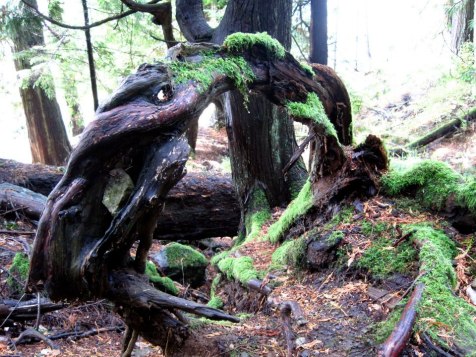



But eventually I stopped. There were too many of them. Instead of getting out the camera each time one presented itself, I simply smiled and waved. Yes, hello. I see you. I’m writing your story.
By the time I left Orcas, Aret was written from beginning to end, but it was only a story, not a book. Now, three years later, after much revision, feedback, and more revision, Aret is a true book. And it’s my favorite kind of book, too – the kind that sweeps up its readers and lets them get lost for awhile.
Now all I have to do is publish it.
And write the next two books, because, as it turns out, Aret is a trilogy.
It’s a good thing days contain all those hours.

 Powered by Dragons